---
title: "The theta-logistic model in R"
description: "Fitting the theta-logistic population growth model in R by maximum likelihood, and why the shape parameter theta is barely identifiable from one time series."
date: "2026-05-15 11:00"
categories: [R, population dynamics, time series, density dependence, maximum likelihood, ecology tutorial]
image: thumbnail.png
image-alt: "Population growth rate against density with two very different theta-logistic curves, a Ricker shape and a sharply concave shape, drawn through the same scatter."
---
The logistic model assumes that per-capita growth falls in a straight line as a population fills up. The theta-logistic relaxes that assumption with one extra exponent, letting the braking be gentle at low density and sudden near the ceiling, or the reverse. It is a popular way to ask what shape density dependence takes. The catch is that the shape parameter is one of the hardest quantities in population ecology to estimate: a single time series usually cannot tell a gentle curve from a sharp one. This post fits the theta-logistic in base R by maximum likelihood and then shows, with a profile likelihood, why the shape parameter should be treated with suspicion.
```{r}
#| label: setup
#| code-fold: true
#| code-summary: "Setup: packages, colours and plot theme"
#| results: hide
#| message: false
#| warning: false
suppressPackageStartupMessages({library(ggplot2); library(dplyr)})
ink<-"#16241d"; body<-"#2c3a31"; forest<-"#275139"; gold<-"#c9b458"
paper<-"#f5f4ee"; line<-"#dad9ca"; faint<-"#5d6b61"; aban<-"#b5534e"; mown<-"#2f8f63"
theme_te <- function(){
  theme_minimal(base_size=12)+
  theme(plot.background=element_rect(fill=paper,colour=NA),
        panel.background=element_rect(fill=paper,colour=NA),
        panel.grid.minor=element_blank(),
        panel.grid.major=element_line(colour=line,linewidth=.3),
        axis.title=element_text(colour=ink), axis.text=element_text(colour=faint),
        plot.title=element_text(colour=ink,size=12,face="bold"),
        strip.text=element_text(colour=ink,face="bold"),
        legend.position="bottom", legend.title=element_text(colour=ink),
        legend.text=element_text(colour=body))
}
```
## The model and the shape parameter
On the log scale the theta-logistic writes the population growth rate as a function of density:
$$N_{t+1} = N_t \exp\!\big[\,r\,(1 - (N_t/K)^{\theta}) + \varepsilon_t\,\big], \qquad \varepsilon_t \sim \mathrm{Normal}(0, \sigma^2).$$
The exponent $\theta$ sets the shape. With $\theta = 1$ the growth rate falls linearly with density, the discrete logistic or Ricker form. With $\theta$ below one the braking acts mostly at low density; with $\theta$ above one the population grows almost unchecked until it nears $K$ and then brakes hard. The trouble is already visible in the equation. Near $K$ the term $1 - (N/K)^{\theta}$ is close to zero for every $\theta$, so the shape only shows itself when the population sits well below $K$. A series that spends most of its time near carrying capacity carries almost no information about $\theta$.
```{r}
#| label: helpers
sim_theta <- function(T,r,K,theta,sigma,N1){ N<-numeric(T); N[1]<-N1
  for(t in 1:(T-1)){ pgr<-r*(1-(N[t]/K)^theta)+rnorm(1,0,sigma)
    N[t+1]<-N[t]*exp(pgr); if(N[t+1]<1) N[t+1]<-1 }
  N }
## process-only negative log-likelihood (sigma profiled out); optional fixed theta
nll <- function(par, pgr, dens, theta_fix=NA){
  r<-exp(par[1]); K<-exp(par[2]); theta<-if(is.na(theta_fix)) exp(par[3]) else theta_fix
  mu<-r*(1-(dens/K)^theta); s2<-mean((pgr-mu)^2); n<-length(pgr)
  0.5*n*(log(2*pi*s2)+1) }
fit_full <- function(N){ pgr<-diff(log(N)); dens<-N[-length(N)]
  op<-optim(c(log(0.3),log(max(N)*1.05),log(1)), nll, pgr=pgr, dens=dens,
            method="BFGS", control=list(maxit=2000))
  s2<-mean((pgr-exp(op$par[1])*(1-(dens/exp(op$par[2]))^exp(op$par[3])))^2)
  list(r=exp(op$par[1]), K=exp(op$par[2]), theta=exp(op$par[3]), sigma=sqrt(s2),
       ll=-op$value, conv=op$convergence) }
fit_theta <- function(N,theta){ pgr<-diff(log(N)); dens<-N[-length(N)]
  op<-optim(c(log(0.3),log(max(N)*1.05)), nll, pgr=pgr, dens=dens, theta_fix=theta,
            method="BFGS", control=list(maxit=2000))
  list(r=exp(op$par[1]), K=exp(op$par[2]), ll=-op$value) }
```
## A series that reaches its ceiling
Simulate forty years from a theta-logistic with a true shape of $\theta = 2.5$, starting at a quarter of carrying capacity so the population climbs and then settles near $K = 1000$.
```{r}
#| label: simulate
r_true<-0.40; K_true<-1000; theta_true<-2.5; sigma_true<-0.10; N1<-250; Tlen<-40
set.seed(12); N <- sim_theta(Tlen, r_true, K_true, theta_true, sigma_true, N1)
```
Fit the full four-parameter model by maximum likelihood. Because the growth-rate residuals are treated as Gaussian, this is a nonlinear least-squares fit of the growth rate on density, with the noise standard deviation falling out as the residual spread.
```{r}
#| label: fit
ff <- fit_full(N)
c(r=round(ff$r,2), K=round(ff$K,0), theta=round(ff$theta,2), sigma=round(ff$sigma,3))
```
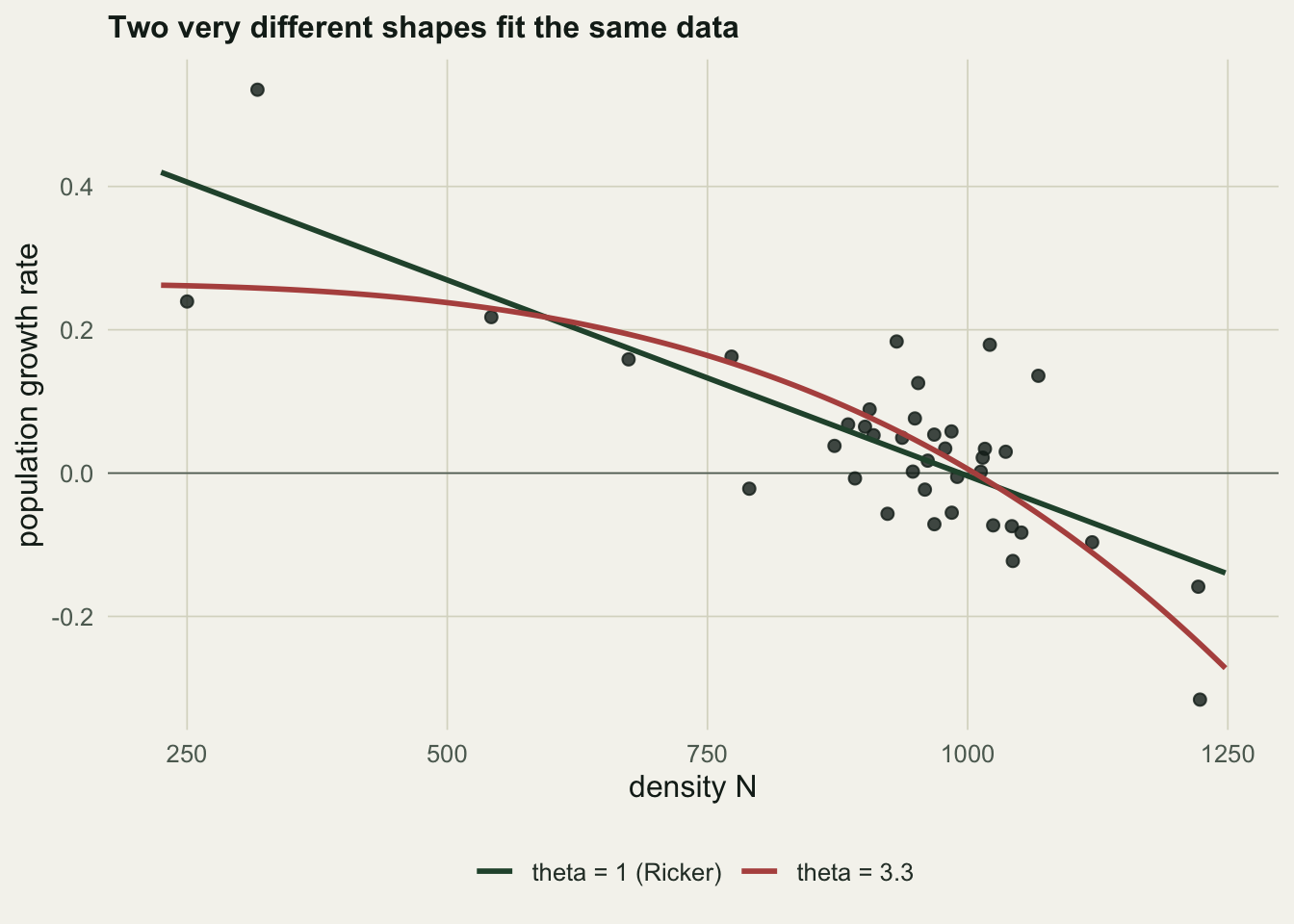
Carrying capacity comes back at `r round(ff$K)`, close to the true $1000$. The growth rate, `r sprintf("%.2f", ff$r)` against a true `r sprintf("%.2f", r_true)`, and the shape parameter, `r sprintf("%.2f", ff$theta)` against a true `r theta_true`, are the pair to be careful with: the two trade off against each other, so a whole range of pairs fits about as well as the best one, and the exact position of the maximum says as much about the noise in one simulated series as about the population behind it. Refitting with the shape pinned at two values far apart gives the likelihood cost of each.
```{r}
#| label: altfits
fR  <- fit_theta(N, 1)      # Ricker: theta fixed at 1
fHi <- fit_theta(N, 3.3)    # a sharply concave shape
c(ricker_ll=round(fR$ll,2), theta3.3_ll=round(fHi$ll,2), ml_ll=round(ff$ll,2),
  ricker_gap=round(ff$ll-fR$ll,2), theta3.3_gap=round(ff$ll-fHi$ll,2))
```
```{r}
#| label: fig-shapes
#| fig-cap: "Population growth rate against density with two fitted theta-logistic curves. A Ricker shape and a sharply concave shape thread the same points, diverging at both ends of the density range where the data are sparse."
#| fig-alt: "Scatter of population growth rate against density, sloping down to zero near density 1000, with a green Ricker curve and a red concave curve almost on top of each other over the data."
pgr<-diff(log(N)); dens<-N[-length(N)]
gx <- seq(min(dens)*0.9, max(dens)*1.02, length.out=250)
curve_df <- rbind(
  data.frame(N=gx, pgr=fR$r*(1-(gx/fR$K)^1),    model="theta = 1 (Ricker)"),
  data.frame(N=gx, pgr=fHi$r*(1-(gx/fHi$K)^3.3), model="theta = 3.3"))
ggplot()+
  geom_hline(yintercept=0, colour=faint, linewidth=.3)+
  geom_point(data=data.frame(N=dens,pgr=pgr), aes(N, pgr), colour=ink, size=1.9, alpha=.8)+
  geom_line(data=curve_df, aes(N, pgr, colour=model), linewidth=1)+
  scale_colour_manual(values=c("theta = 1 (Ricker)"=forest,"theta = 3.3"=aban))+
  labs(x="density N", y="population growth rate", colour=NULL,
       title="Two very different shapes against the same data")+
  theme_te()
```
On this series the Ricker fit sits $0.77$ log-likelihood units below the best fit, a deviance of about $1.5$, under the value of $3.84$ that would mark a real difference. The sharply concave $\theta = 3.3$ fit is inside that margin as well. Which of the two stays inside it is a property of the series rather than of the method: another series of the same length from this population can push the Ricker deviance past that threshold and leave the concave fit as the one that cannot be told apart from the best. What holds throughout is the reason the comparison is so weak, that the two curves are closest over the middle of the density range and separate at its two ends, where a settled population supplies few observations.
## The likelihood ridge
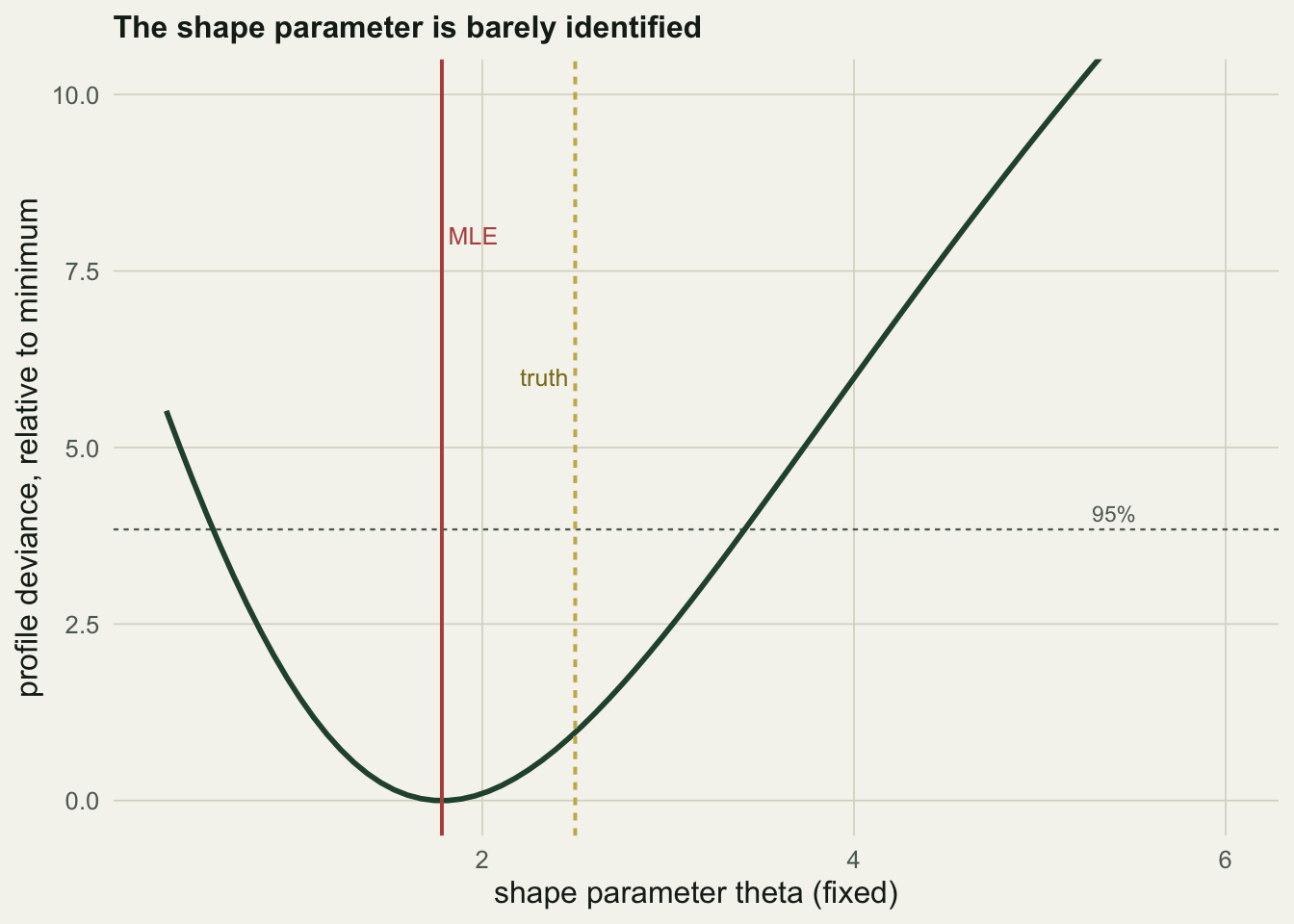
Fixing the shape parameter at a grid of values and re-optimising the rest traces the profile likelihood for $\theta$. It is nearly flat across a wide range, the ridge described by Polansky and colleagues.
```{r}
#| label: profile
tg <- seq(0.3, 6, length.out=80)
pl <- lapply(tg, function(x) fit_theta(N, x))
llp <- sapply(pl, function(z) z$ll); rp <- sapply(pl, function(z) z$r)
dev <- 2*(max(llp) - llp)
c(theta_lo=round(min(tg[dev<3.84]),1), theta_hi=round(max(tg[dev<3.84]),1),
  r_lo=round(min(rp[dev<3.84]),2), r_hi=round(max(rp[dev<3.84]),2))
```
```{r}
#| label: fig-profile
#| fig-cap: "Profile deviance for the shape parameter. The curve stays below the 95 per cent threshold across a wide band, so theta is only weakly identified, and the true value of 2.5 is well inside the interval."
#| fig-alt: "Profile deviance curve against theta, a shallow valley that stays low between about 0.6 and 3.4, with a dashed threshold line, the maximum likelihood estimate, and the true value marked."
d2 <- data.frame(theta=tg, dev=dev)
ggplot(d2, aes(theta, dev))+
  geom_hline(yintercept=3.84, colour=faint, linetype="22", linewidth=.4)+
  geom_line(colour=forest, linewidth=1)+
  geom_vline(xintercept=ff$theta, colour=aban, linewidth=.7)+
  geom_vline(xintercept=theta_true, colour=gold, linewidth=.7, linetype="22")+
  annotate("text", x=ff$theta, y=8, label=" MLE", hjust=0, colour=aban, size=3.3)+
  annotate("text", x=theta_true, y=6, label="truth ", hjust=1, colour="#8a7a1e", size=3.3)+
  annotate("text", x=5.4, y=3.84, label="95%", vjust=-0.5, colour=faint, size=3)+
  coord_cartesian(ylim=c(0,10))+
  labs(x="shape parameter theta (fixed)", y="profile deviance, relative to minimum",
       title="The shape parameter is barely identified")+
  theme_te()
```
Any shape between $0.6$ and $3.4$ falls within a likelihood interval of the best fit, so on this series the data are consistent with a gentle Ricker curve, the true value of $2.5$, and a sharp bend near the ceiling all at once. Which shapes the band admits is a property of the series in hand rather than of the method: another forty years from the same population can push the lower limit above one and rule the Ricker form out, and still leave a band far too wide to settle the shape. The reason the estimate is so loose is a trade-off with the growth rate: as $\theta$ climbs along the ridge, the fitted $r$ slides from $0.77$ down to $0.26$ to keep the predictions the same. Growth rate and shape are entangled, and one series cannot separate them.
## What to do about it
The practical response is to stop trying to estimate the shape from a single series. Fixing $\theta = 1$ and fitting the Ricker model is the common and defensible choice, and for this series it costs almost nothing in fit while removing an unidentified parameter; the extinction and density-dependence work in these posts uses that linear form for the same reason. Where the shape genuinely matters, the information has to come from elsewhere: a population pushed well below carrying capacity so the low-density curve is actually observed, several populations fitted together, or an informative prior in a Bayesian fit. The general lesson carries across this whole set of time-series methods. A model can be written down and fitted, and still contain parameters the data cannot resolve, so a profile likelihood is worth as much as the point estimate it surrounds. The same weak-identifiability caution applies to the [density-dependence slope](../detecting-density-dependence/) and to the [split between process and observation error](../gompertz-state-space-model/).
## References
Polansky L, de Valpine P, Lloyd-Smith JO & Getz WM 2009 Ecology 90(8):2313-2320 (10.1890/08-1461.1)
Gilpin ME & Ayala FJ 1973 Proceedings of the National Academy of Sciences 70(12):3590-3593 (10.1073/pnas.70.12.3590)
Ricker WE 1954 Journal of the Fisheries Research Board of Canada 11(5):559-623 (10.1139/f54-039)
## Related tutorials
- [Detecting density dependence](../detecting-density-dependence/)
- [Extinction risk and population viability analysis](../extinction-risk-pva/)
- [Surplus production models in R](../surplus-production-models/)
- [Parameter scale decides what optim() finds](../parameter-scale-and-what-optim-finds/)