---
title: "The ideal free distribution"
description: "The ideal free distribution in R: how equal competitors free to move distribute across patches to equalise their intake, and why the result is input matching."
date: "2026-07-02 14:00"
date-modified: "2026-10-15"
categories: [ecology tutorial, R, foraging, behaviour, habitat selection]
image: thumbnail.png
image-alt: "Bars showing the fraction of foragers in each patch matching the fraction of resources, with per-capita intake equal across patches."
---
*Corrected 15 October 2026: the post said that the distribution of ideal, free animals is fixed by the resources alone, so that any departure from matching points to an assumption breaking; it now says that this also needs the animals to divide each patch's input equally, and that interference alone can pull ideal, free animals off matching.*
*Corrected 7 October 2026: under crowding, the intake figure showed each empty patch as its input divided by half a forager, twice what anyone could get there; it now shows what the first forager to move there would get.*
```{r setup}
#| code-fold: true
#| code-summary: "Setup: packages, colours and plot theme"
#| results: hide
#| message: false
#| warning: false
knitr::opts_chunk$set(echo = TRUE, message = FALSE, warning = FALSE,
                      dev = "png", dpi = 120, fig.path = "figures/",
                      fig.width = 7, fig.height = 4.4)
library(ggplot2)
theme_te <- theme_minimal(base_size = 12) +
  theme(panel.background = element_rect(fill = "#f5f4ee", colour = NA),
        plot.background  = element_rect(fill = "#f5f4ee", colour = NA),
        panel.grid.minor = element_blank(),
        plot.title = element_text(face = "bold", size = 12))
theme_set(theme_te)
col_for <- "#3a6b52"; col_res <- "#b5651d"; col_ref <- "#555555"

Q <- c(30, 20, 10); N <- 60
n <- c(N, 0, 0)
for (s in 1:3000) {
  intake <- Q / pmax(n, 0.5)
  from <- which(n > 0)[which.min(intake[n > 0])]; to <- which.max(intake)
  if (from != to) { n[from] <- n[from] - 1; n[to] <- n[to] + 1 }
}
intake_eq <- Q / n
```
Resources are patchy, animals can move, and every animal wants the richest patch. But if they all crowd into the richest patch, it stops being the richest, because they share it. Where does everyone end up? Fretwell and Lucas 1969 Acta Biotheoretica 19(1):16-36 answered this with a model so clean it still frames the subject: the ideal free distribution.
## Ideal, and free
The two words are the assumptions. **Ideal**: each animal knows the quality of every patch. **Free**: nothing stops it from settling anywhere, no territory, no travel cost, no fighting. Given both, an animal will keep moving as long as some other patch offers it more, and it stops only when no move would help. At that point every occupied patch delivers the same per-capita intake, because if one paid better the animals elsewhere would already have moved into it. The distribution is an equilibrium of self-interest: nobody can do better by switching.
Model it directly. Let patches receive resources at rates `Q`, shared among whoever is there, so intake in a patch is its input divided by its occupants. Start everyone in the best patch and let them move to wherever intake is currently highest.
```{r settle}
Q <- c(30, 20, 10); N <- 60          # input rates of three patches; number of foragers
n <- c(N, 0, 0)                       # start all foragers in patch 1
for (s in 1:3000) {
  intake <- Q / pmax(n, 0.5)          # per-capita intake; an empty patch scores twice its input
  from <- which(n > 0)[which.min(intake[n > 0])]
  to   <- which.max(intake)
  if (from != to) { n[from] <- n[from] - 1; n[to] <- n[to] + 1 }  # move toward the best
}
rbind(foragers = n, intake = round(Q / n, 2))
```
## Input matching
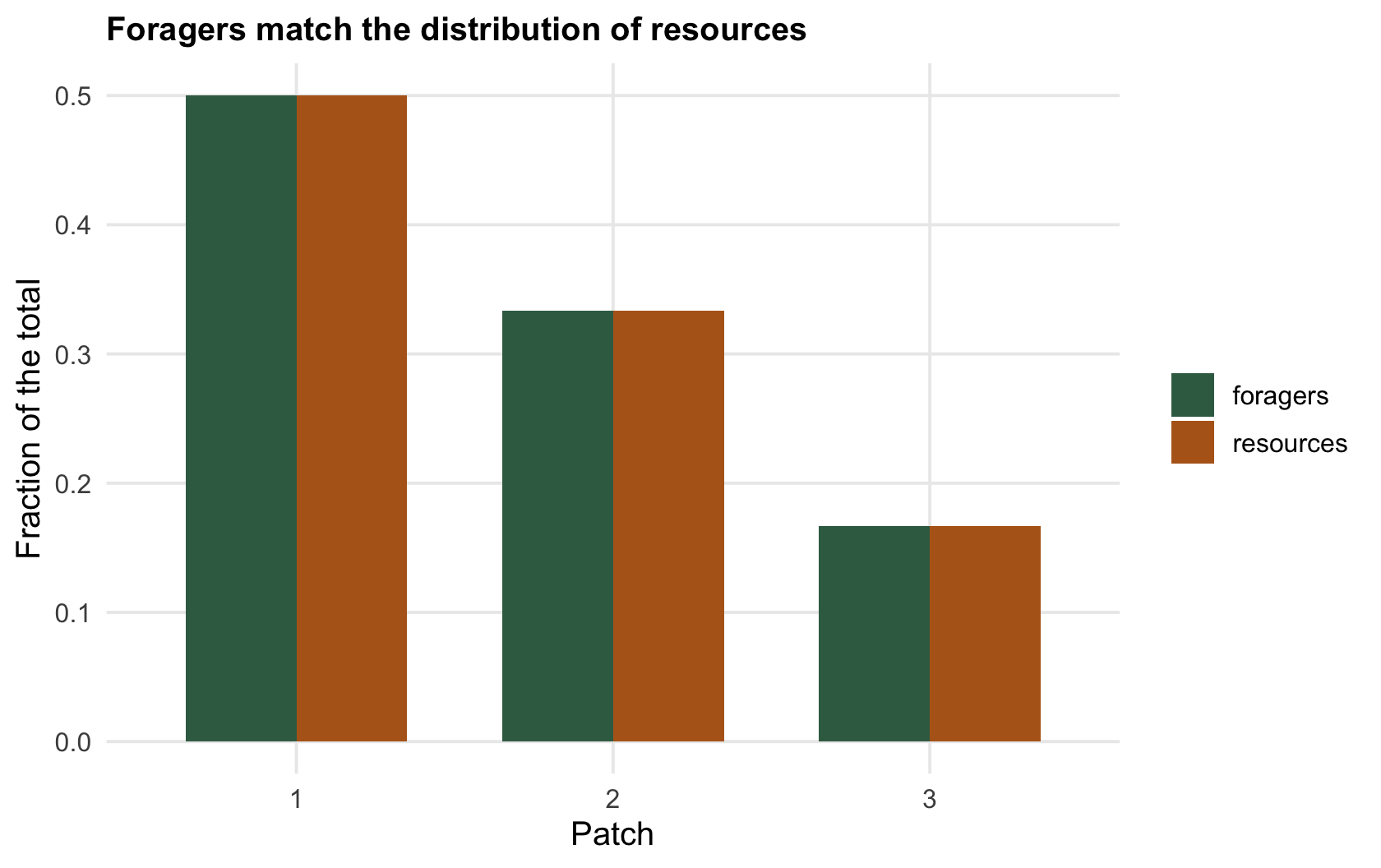
The equilibrium has a strikingly simple form. Per-capita intake is equal everywhere, `r sprintf("%.1f", intake_eq[1])` in every patch. And equal intake means input divided by occupants is the same across patches, which forces the number of occupants to be proportional to the input. The fraction of animals in a patch equals the fraction of the resources it supplies.
```{r matching}
c(forager_fractions = round(n / N, 3), resource_fractions = round(Q / sum(Q), 3))
```
The three patches supply `r sprintf("%.0f", 100*Q[1]/sum(Q))`, `r sprintf("%.0f", 100*Q[2]/sum(Q))` and `r sprintf("%.0f", 100*Q[3]/sum(Q))` per cent of the resources, and they end up holding exactly those fractions of the foragers. This is **input matching**, the central prediction of the ideal free distribution: animals track resources in proportion, so a patch twice as rich holds twice as many competitors and nobody eats any better for being there.
```{r fig-matching}
#| fig-cap: "The ideal free distribution. The fraction of foragers in each patch (green) matches the fraction of resources it supplies (ochre), and per-capita intake ends up equal across all three patches."
#| fig-alt: "Grouped bars for three patches; in each the forager fraction and resource fraction are equal, illustrating input matching."
d <- rbind(data.frame(patch = factor(1:3), frac = n/N,      what = "foragers"),
           data.frame(patch = factor(1:3), frac = Q/sum(Q), what = "resources"))
ggplot(d, aes(patch, frac, fill = what)) +
  geom_col(position = "dodge", width = 0.7) +
  scale_fill_manual(values = c("foragers" = col_for, "resources" = col_res)) +
  labs(x = "Patch", y = "Fraction of the total", fill = NULL,
       title = "Foragers match the distribution of resources")
```
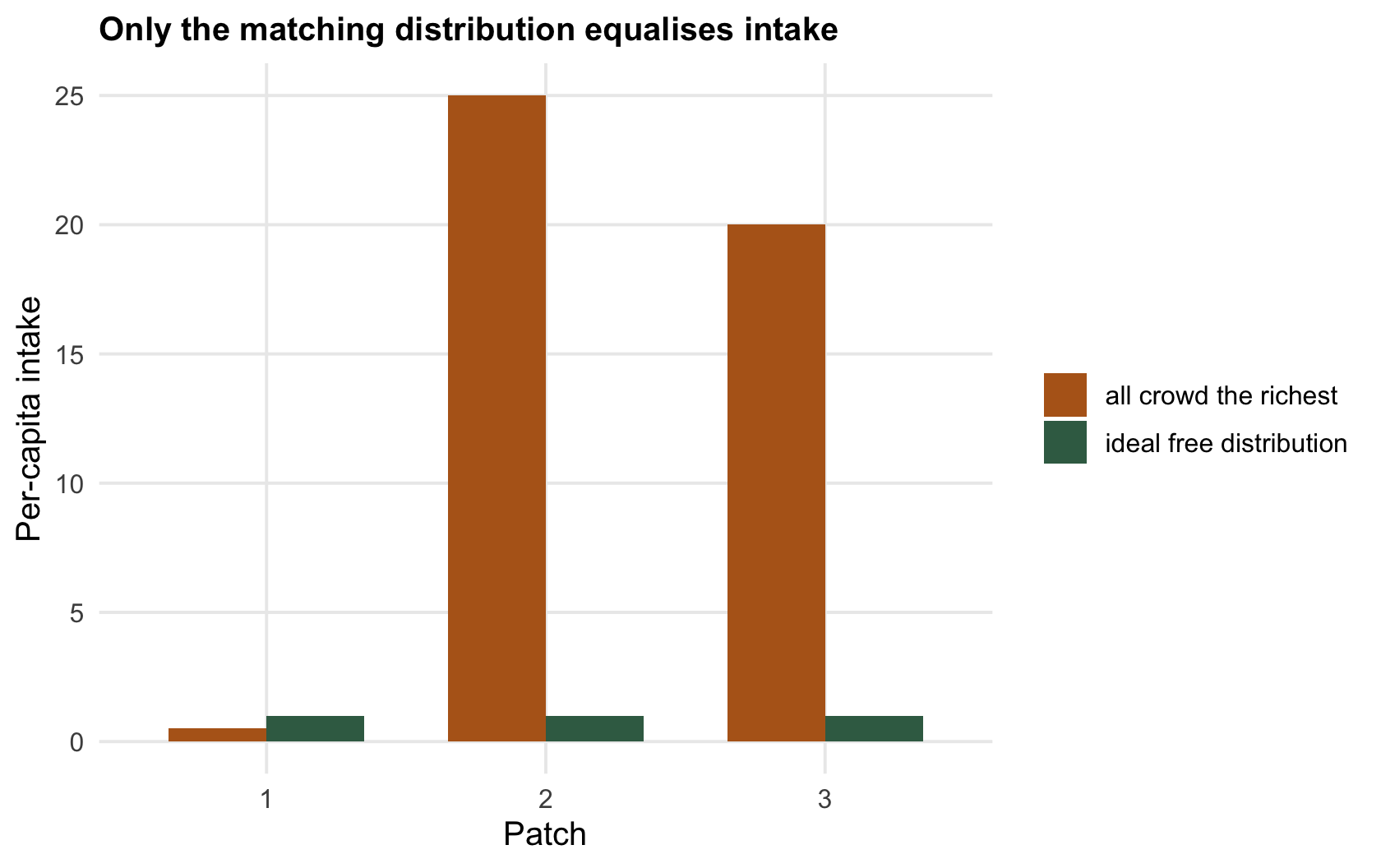
The equilibrium is stable because any other arrangement leaves someone able to improve. Pile everyone into the richest patch and its per-capita intake crashes below the empty ones, so movement pays; only the matching distribution leaves no such incentive.
```{r fig-intake}
#| fig-cap: "Per-capita intake in each patch under two arrangements. Crowd all foragers into the richest patch (ochre) and intake there is far below what the first forager to move to either empty patch would get, shown by the other two ochre bars; at the ideal free distribution (green) intake is identical across patches."
#| fig-alt: "Grouped bars of per-capita intake per patch; under crowding the first patch is far lower than the others, under the ideal free distribution all three are equal."
crowd <- c(Q[1]/N, Q[2]/1, Q[3]/1)          # everyone in patch 1; empty patches: a first arrival's intake
di <- rbind(data.frame(patch = factor(1:3), intake = crowd, arrangement = "all crowd the richest"),
            data.frame(patch = factor(1:3), intake = Q/n,             arrangement = "ideal free distribution"))
ggplot(di, aes(patch, intake, fill = arrangement)) +
  geom_col(position = "dodge", width = 0.7) +
  scale_fill_manual(values = c("all crowd the richest" = col_res, "ideal free distribution" = col_for)) +
  labs(x = "Patch", y = "Per-capita intake", fill = NULL,
       title = "Only the matching distribution equalises intake")
```
## Why it matters, and where it bends
Input matching is more than a foraging curiosity. It says that density tracks resources, not fitness: every animal does equally well no matter which patch it is in, so a crowded patch is not a good patch, it is a rich one with a lot of competitors, the same warning that runs through source-sink dynamics. It also gives a null model. If animals really are ideal and free and simply divide each patch's input equally among themselves, their distribution is fixed by the resources alone, and any departure from matching points to one of these conditions breaking, though not necessarily ideal or free: interference, where crowding cuts each forager's intake below an equal share of the input, can pull even ideal, free animals off matching. Real animals depart from it constantly, almost always in the same direction, under-using the best patches, which the [next post](../input-matching-and-undermatching/) measures. And when what animals equalise is fitness rather than instantaneous intake, the prediction becomes the isodar of [density-dependent habitat selection](../density-dependent-habitat-selection-isodars/). The assumptions that make the model clean are exactly what the [checking post](../checking-an-ideal-free-analysis/) interrogates.
## References
- Fretwell SD, Lucas HL 1969. Acta Biotheoretica 19(1):16-36 (10.1007/BF01601953).
## Related tutorials
- [Input matching and undermatching](../input-matching-and-undermatching/)
- [Density-dependent habitat selection and isodars](../density-dependent-habitat-selection-isodars/)
- [Checking an ideal free analysis](../checking-an-ideal-free-analysis/)
- [The marginal value theorem](../the-marginal-value-theorem/)