kf_nll <- function(par, y, fixed_so2=NA){
  a<-par[1]; b<-tanh(par[2]); sp2<-exp(par[3])
  so2 <- if(is.na(fixed_so2)) exp(par[4]) else fixed_so2
  T<-length(y); xp<-a/(1-b); Pp<-sp2/(1-b^2); ll<-0
  for(t in 1:T){
    v<-y[t]-xp; S<-Pp+so2; K<-Pp/S      # innovation, its variance, Kalman gain
    xf<-xp+K*v; Pf<-(1-K)*Pp            # filtered state and variance
    ll<-ll-0.5*(log(2*pi*S)+v*v/S)      # log-likelihood contribution
    xp<-a+b*xf; Pp<-b^2*Pf+sp2          # predict the next state
  }
  -ll
}
fit_gss <- function(y){
  n<-length(y); x0<-y[-n]; x1<-y[-1]; b0<-cov(x0,x1)/var(x0); a0<-mean(x1)-b0*mean(x0)
  vr<-var(x1-(a0+b0*x0)); b0<-min(max(b0,-0.9),0.9)
  st<-c(a0, atanh(b0), log(0.5*vr), log(0.5*vr))
  op<-optim(st, kf_nll, y=y, method="BFGS", hessian=TRUE, control=list(maxit=1000))
  b<-tanh(op$par[2]); V<-tryCatch(solve(op$hessian), error=function(e) matrix(NA,4,4))
  se_tb<-sqrt(V[2,2])
  list(a=op$par[1], b=b, sp=sqrt(exp(op$par[3])), so=sqrt(exp(op$par[4])),
       theta_b=op$par[2], se_tb=se_tb, se_b=(1-b^2)*se_tb, conv=op$convergence, ll=-op$value)
}
naive_b <- function(y){ n<-length(y); cov(y[-n],y[-1])/var(y[-n]) }
kf_smooth <- function(y,a,b,sp2,so2){ T<-length(y)
  xp<-xf<-Pp<-Pf<-numeric(T); m<-a/(1-b); P<-sp2/(1-b^2)
  for(t in 1:T){ xp[t]<-m; Pp[t]<-P; v<-y[t]-m; S<-P+so2; K<-P/S
    xf[t]<-m+K*v; Pf[t]<-(1-K)*P; m<-a+b*xf[t]; P<-b^2*Pf[t]+sp2 }
  xs<-numeric(T); xs[T]<-xf[T]
  for(t in (T-1):1){ C<-Pf[t]*b/Pp[t+1]; xs[t]<-xf[t]+C*(xs[t+1]-xp[t+1]) }
  xs
}Gompertz state-space model in R
R
population dynamics
time series
state-space models
density dependence
ecology tutorial
Separating process noise from observation error in a population time series with a Gompertz state-space model in R, fitted by a hand-coded Kalman filter.
The test for density dependence works on true abundances, but real counts carry sampling error. That error is not harmless. When the counts feeding a Gompertz regression are noisy, the density-dependence slope is pulled downwards, so a population is made to look more tightly regulated than it is. The Gompertz state-space model fixes the diagnosis by treating the true abundance as a hidden state and the counts as noisy observations of it, then estimating the process noise and the observation error separately. This post fits that model in base R with a Kalman filter written by hand, shows how much bias it removes, and shows why the split between the two error sources is hard to pin down.
Two sources of variation
The model has two layers. A hidden process describes the real log abundance, and an observation layer describes what gets counted:
\[X_{t+1} = a + b\,X_t + \varepsilon_t, \quad \varepsilon_t \sim \mathrm{Normal}(0, \sigma_p^2),\] \[Y_t = X_t + \eta_t, \quad \eta_t \sim \mathrm{Normal}(0, \sigma_o^2).\]
Here \(X_t\) is the true log abundance, hidden from view, and \(Y_t\) is the observed log count. The process variance \(\sigma_p^2\) is genuine population fluctuation; the observation variance \(\sigma_o^2\) is counting error. The slope \(b\) still measures density dependence exactly as before, with \(b < 1\) meaning regulation. The problem with the naive regression from the previous post is that it treats \(Y_t\) as if it were \(X_t\), so the noise in the predictor drags the estimated slope towards zero.
The Kalman filter likelihood
A linear Gaussian state-space model has a likelihood that the Kalman filter computes exactly. The filter sweeps through the years, and at each step it holds a prediction of the hidden state and its variance. It compares that prediction with the new observation, and the mismatch, weighted by how much to trust the observation, both updates the state estimate and contributes to the log-likelihood. The recursion is short enough to write out in full.
A series with counting error
Simulate fifty years of a density-dependent population (\(b = 0.70\), equilibrium \(N^{*} = 200\)) and then observe it with counting error. Process and observation standard deviations are set equal, both \(0.15\) on the log scale, so neither source dominates.
b_true<-0.70; sp_true<-0.15; so_true<-0.15
Xstar<-log(200); a_true<-(1-b_true)*Xstar; Tlen<-50

set.seed(201)
Xstate <- numeric(Tlen); Xstate[1]<-Xstar
for(t in 1:(Tlen-1)) Xstate[t+1] <- a_true + b_true*Xstate[t] + rnorm(1,0,sp_true)
Yobs <- Xstate + rnorm(Tlen, 0, so_true)     # observed counts on the log scale
Fit the naive Gompertz regression to the counts, then fit the full state-space model.
nb <- naive_b(Yobs)
f  <- fit_gss(Yobs)
ci_b <- tanh(f$theta_b + c(-1,1)*1.96*f$se_tb)

round(c(naive_slope=nb, gss_b=f$b, ci_lo=ci_b[1], ci_hi=ci_b[2],
        gss_sp=f$sp, gss_so=f$so), 3)
naive_slope gss_b ci_lo ci_hi gss_sp gss_so
0.361 0.589 -0.150 0.906 0.144 0.144 The naive slope comes out at \(0.36\), far below the true value of \(0.70\): taken at face value, the counts suggest strong density dependence that is not there. The state-space model gives \(\hat b = 0.59\), much closer to the truth, and it splits the variability cleanly, estimating a process standard deviation of \(0.144\) and an observation standard deviation of \(0.144\), both close to the true \(0.15\). The state-space estimate of the hidden trajectory tracks the true abundance through the observation noise.
xs <- kf_smooth(Yobs, f$a, f$b, f$sp^2, f$so^2)
d1 <- data.frame(year=1:Tlen, true=Xstate, obs=Yobs, smooth=xs)
ggplot(d1, aes(year))+
  geom_line(aes(y=true, colour="True log abundance"), linewidth=.9)+
  geom_point(aes(y=obs, colour="Observed count"), size=1.8, alpha=.9)+
  geom_line(aes(y=smooth, colour="State-space estimate"), linewidth=.9, linetype="22")+
  scale_colour_manual(values=c("True log abundance"=forest,"Observed count"=gold,"State-space estimate"=aban))+
  labs(x="year", y="log abundance", colour=NULL,
       title="Observed counts are a noisy view of the true state")+
  theme_te()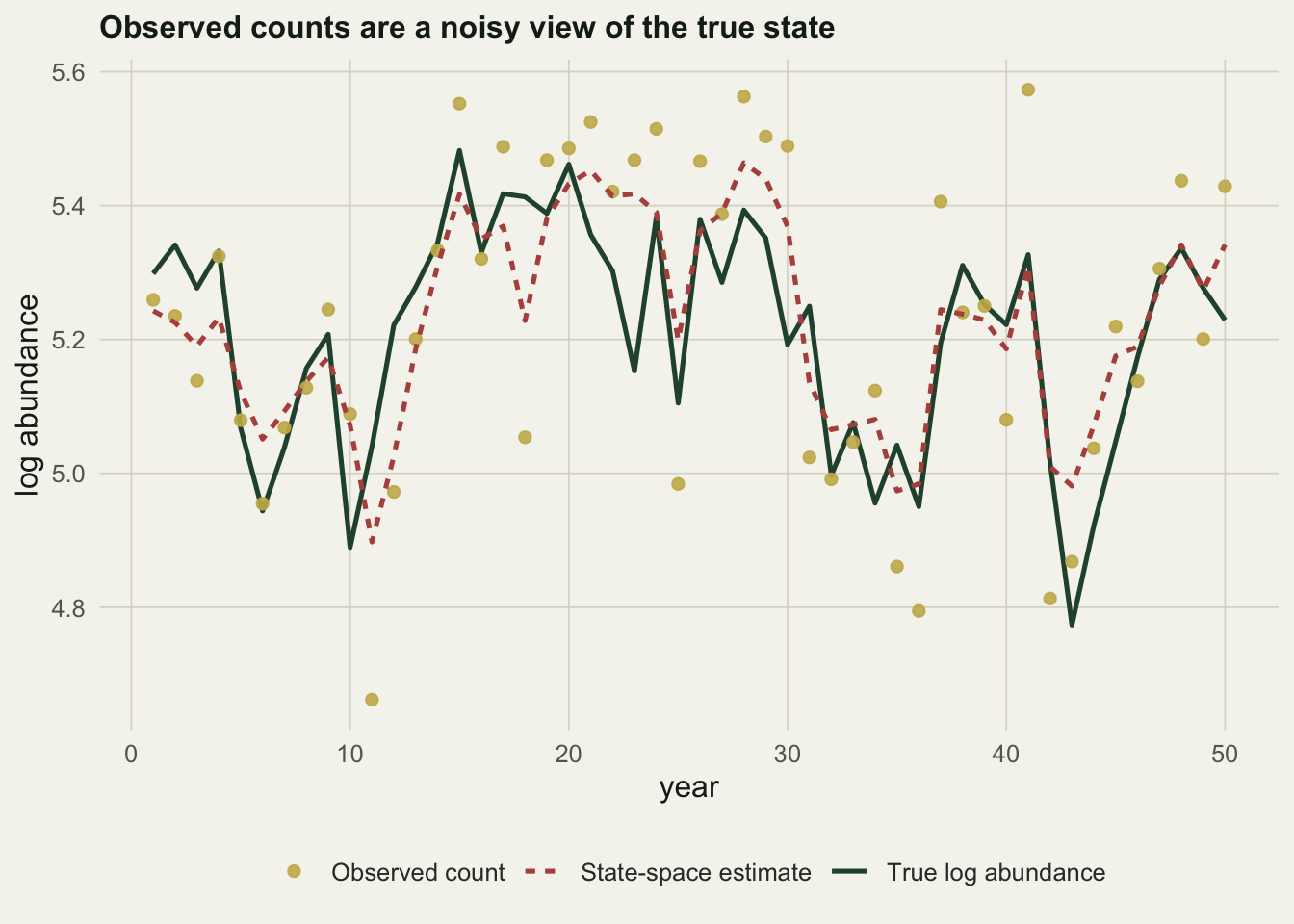
Does it remove the bias?
One series is an anecdote. To see the average behaviour, generate four hundred series from the same model and compare the naive slope with the state-space slope across all of them.
set.seed(7100); M<-400; nbv<-numeric(M); gbv<-numeric(M); cv<-integer(M)
for(i in 1:M){ x<-numeric(Tlen); x[1]<-Xstar
  for(t in 1:(Tlen-1)) x[t+1]<-a_true+b_true*x[t]+rnorm(1,0,sp_true)
  y<-x+rnorm(Tlen,0,so_true); nbv[i]<-naive_b(y); ff<-fit_gss(y); gbv[i]<-ff$b; cv[i]<-ff$conv }
round(c(naive_mean=mean(nbv), gss_mean=mean(gbv[cv==0]),
        gss_sd=sd(gbv[cv==0])), 3)
naive_mean gss_mean gss_sd
0.385 0.549 0.226 The naive slope averages \(0.39\), a downward bias of about \(0.32\); the state-space slope averages \(0.55\), a bias of about \(0.15\). Accounting for observation error roughly halves the bias, which is the payoff the model is designed for. It does not remove the bias entirely at this series length, and the spread across series is wide (a standard deviation of about \(0.23\)), so a single estimate should be read as approximate.
Why the split is hard
The residual bias and the wide spread are not a coding problem; they are a property of the model. The strength of density dependence and the two variances are only weakly separable from a single series. Fixing the observation variance at a grid of values and re-optimising the rest traces the profile likelihood, and it is nearly flat over a wide range.
so_grid <- seq(0.02, 0.34, by=0.01)
prof <- sapply(so_grid, function(so){
  st<-c(f$a, atanh(min(max(nb,-0.9),0.9)), log(0.02))
  op<-optim(st, kf_nll, y=Yobs, fixed_so2=so^2, method="BFGS", control=list(maxit=1000))
  -op$value })
prof_rel <- prof - max(prof)
range(so_grid[prof_rel > -1.92])   # observation SD values within a 95% likelihood interval
[1] 0.02 0.22Any observation standard deviation between about \(0.02\) and \(0.22\) sits within a likelihood interval of the maximum. The data barely distinguish almost no counting error from a substantial amount of it, even though the total variability is well determined: the fitted total standard deviation is \(0.204\) against a true \(0.212\). The whole is pinned down; the partition is not.
d2 <- data.frame(so=so_grid, rel=prof_rel)
ggplot(d2, aes(so, rel))+
  geom_hline(yintercept=-1.92, colour=faint, linetype="22", linewidth=.4)+
  geom_line(colour=forest, linewidth=1)+
  geom_vline(xintercept=f$so, colour=aban, linewidth=.7)+
  geom_vline(xintercept=so_true, colour=gold, linewidth=.7, linetype="22")+
  annotate("text", x=f$so, y=0, label=" MLE", hjust=0, vjust=1.4, colour=aban, size=3.3)+
  annotate("text", x=so_true, y=-3.2, label="truth ", hjust=1, colour="#8a7a1e", size=3.3)+
  labs(x="observation standard deviation (fixed)", y="profile log-likelihood, relative to maximum",
       title="The observation-error variance is barely identified")+
  theme_te()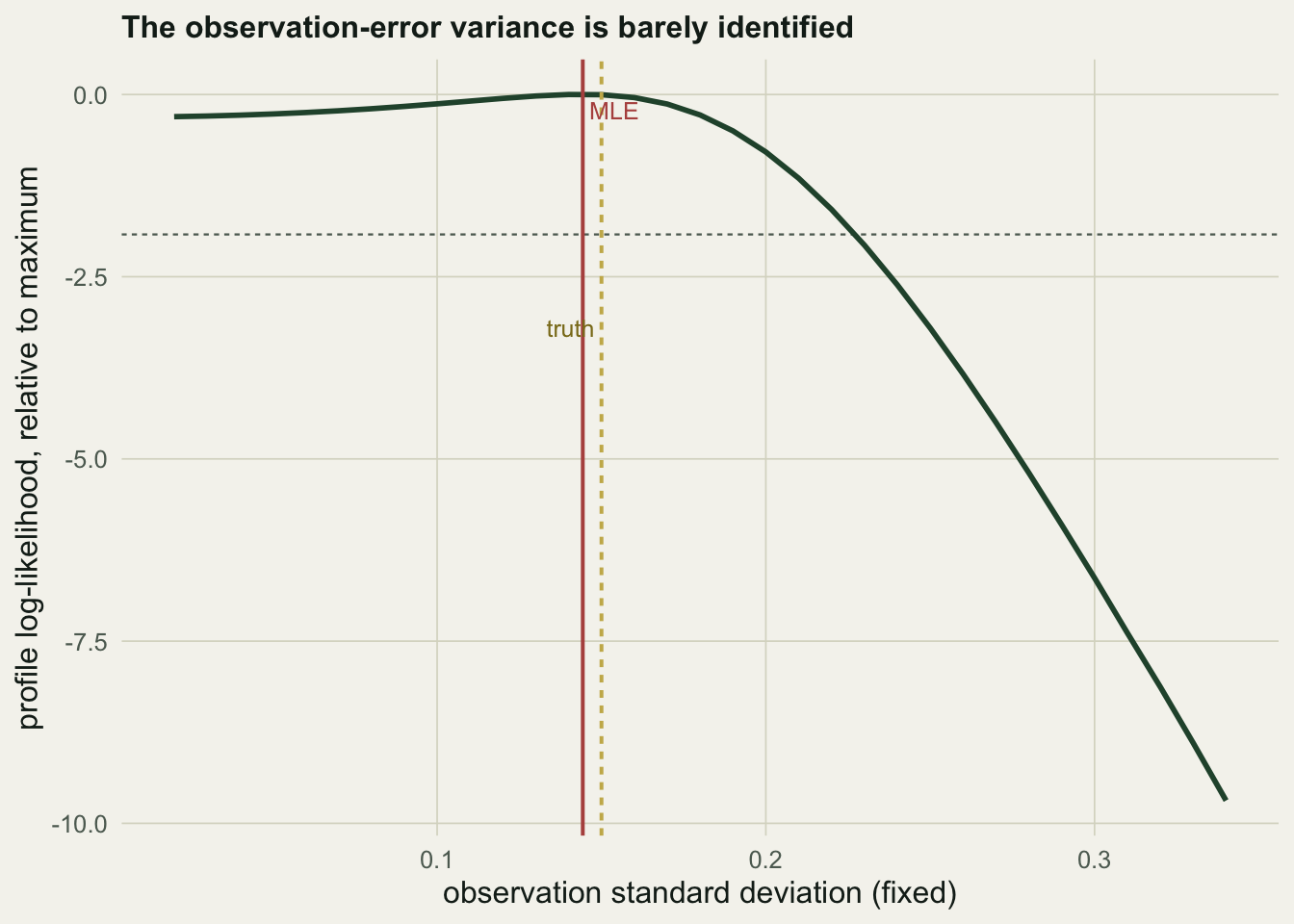
This weak identifiability, described by Knape, is why the confidence interval for the slope on the single series runs from \(-0.15\) to \(0.91\): the model is confident there is some density dependence but cannot say how strong, because that answer depends on a variance split the data cannot resolve. The practical advice follows directly. Use the state-space model to avoid the gross bias of ignoring observation error, but do not over-read the individual variance components from a short series, and where an independent estimate of counting error exists, fix the observation variance rather than trying to estimate it. Once density dependence and its measurement are in hand, the natural next question is simply which way the population is heading, which is the subject of estimating a population trend.
References
Dennis B, Ponciano JM, Lele SR, Taper ML & Staples DF 2006 Ecological Monographs 76(3):323-341 (10.1890/0012-9615(2006)76[323:EDDPNA]2.0.CO;2)
Knape J 2008 Ecology 89(11):2994-3000 (10.1890/08-0071.1)
de Valpine P & Hastings A 2002 Ecological Monographs 72(1):57-76 (10.1890/0012-9615(2002)072[0057:FPMIPN]2.0.CO;2)
Bulmer MG 1975 Biometrics 31(4):901-911 (PMID 1203431)