---
title: "Modelling inhomogeneous point patterns in R"
description: "Fit an inhomogeneous Poisson process in base R: kernel intensity, a trend via Poisson GLM, and the inhomogeneous K that separates trend from interaction."
date: "2026-05-12 15:00"
categories: [R, spatial, point patterns, ecology tutorial]
image: thumbnail.png
image-alt: "A point pattern over a gradient intensity surface beside two panels of L(r) minus r: homogeneous K showing spurious clustering and inhomogeneous K staying flat."
---
Every method so far has rested on one assumption: that the expected density of points is the same everywhere in the study area. When that holds, any structure Ripley's K picks up is genuine interaction between points. When it fails, the whole reading changes. A species that is simply more common on warmer slopes will pack more points into the warm end of a map, and those points will sit closer together there, and a homogeneous K will call that clustering. It is not clustering in any biological sense. It is a first-order trend in abundance masquerading as a second-order interaction.
Separating the two is the point of this post. We simulate a pattern whose density varies with an environmental gradient but whose points are otherwise independent, show that a naive K reports clustering that is not there, then fit the trend and use the inhomogeneous K to strip it out. What remains is a flat curve, correctly telling us there is no interaction once the trend is accounted for.
## Simulating an inhomogeneous Poisson process
We let the intensity, the expected number of points per unit area, rise log-linearly along a covariate that runs from one edge of the window to the other. The covariate here is a simple gradient, standing in for temperature, elevation or any smoothly varying driver.
The standard way to place points under a varying intensity is thinning, due to Lewis and Shedler. Generate a homogeneous pattern at the maximum intensity, then keep each candidate point with a probability equal to the local intensity divided by that maximum. Points survive in proportion to the local rate, which reproduces the target process exactly.
```{r}
#| label: setup
#| message: false
#| warning: false
library(ggplot2)
library(dplyr)
library(tidyr)

te_ink    <- "#16241d"; te_body   <- "#2c3a31"; te_forest <- "#275139"
te_label  <- "#46604a"; te_sage   <- "#93a87f"; te_paper  <- "#f5f4ee"
te_line   <- "#dad9ca"; te_faint  <- "#5d6b61"; te_gold   <- "#c9b458"
te_rust   <- "#b5534e"

theme_te <- function(base_size = 12) {
  theme_minimal(base_size = base_size) +
    theme(
      panel.grid.minor = element_blank(),
      panel.grid.major = element_line(colour = te_line, linewidth = 0.3),
      plot.background  = element_rect(fill = te_paper, colour = NA),
      panel.background = element_rect(fill = te_paper, colour = NA),
      text        = element_text(colour = te_body),
      plot.title  = element_text(colour = te_ink, face = "bold"),
      axis.title  = element_text(colour = te_label),
      axis.text   = element_text(colour = te_faint),
      strip.text  = element_text(colour = te_ink, face = "bold"),
      legend.text = element_text(colour = te_body)
    )
}

A <- 1
b0 <- 5.17; b1 <- 1.5                      # true intensity coefficients
covariate <- function(x, y) 2 * (x - 0.5)  # gradient, ranges over -1 to 1
intensity <- function(x, y) exp(b0 + b1 * covariate(x, y))
lam_max   <- exp(b0 + b1 * 1)              # maximum, at the high edge

set.seed(7801)
N_max <- rpois(1, lam_max * A)
ux <- runif(N_max); uy <- runif(N_max)
keep <- runif(N_max) < intensity(ux, uy) / lam_max
X <- data.frame(x = ux[keep], y = uy[keep])
n <- nrow(X)
n
```
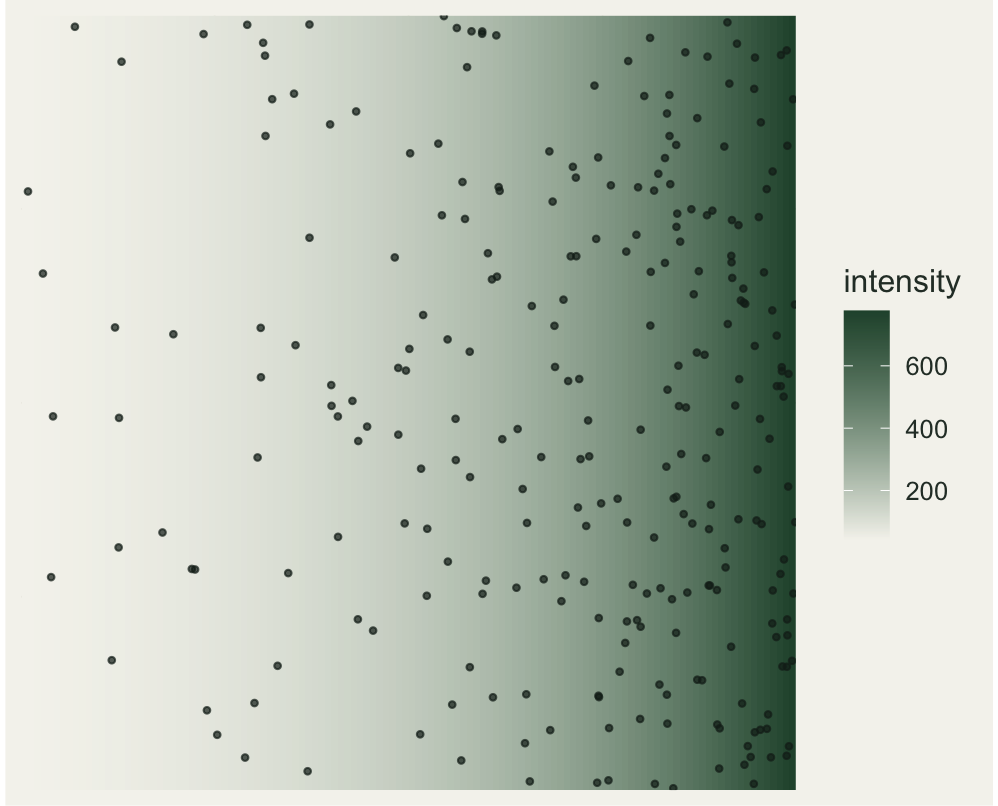
Thinning a maximum of `r N_max` candidates leaves `r n` points, packed towards the high-intensity edge. Drawn over the true intensity surface, the gradient in density is obvious, and it is exactly the kind of gradient that a homogeneous analysis would misread.
```{r}
#| label: fig-intensity
#| fig-cap: "The simulated pattern over its true intensity surface, denser towards the high-intensity edge."
#| fig-alt: "A square panel with a background shaded from pale to dark along the horizontal axis, and points scattered on top that grow denser towards the darker, high-intensity edge."
#| fig-width: 5.2
#| fig-height: 4.2
grid <- expand.grid(x = seq(0.005, 0.995, length.out = 120),
                    y = seq(0.005, 0.995, length.out = 120))
grid$lam <- intensity(grid$x, grid$y)
ggplot() +
  geom_raster(data = grid, aes(x, y, fill = lam)) +
  geom_point(data = X, aes(x, y), colour = te_ink, size = 0.8, alpha = 0.7) +
  scale_fill_gradient(low = te_paper, high = te_forest, name = "intensity") +
  coord_equal(expand = FALSE) +
  labs(x = NULL, y = NULL) +
  theme_te() +
  theme(axis.text = element_blank(), panel.grid = element_blank(),
        legend.position = "right")
```
## Fitting the trend with a Poisson GLM
To recover the trend we divide the window into a grid of cells, count the points in each, and model the counts. A Poisson process carved into cells produces Poisson counts whose mean is the intensity integrated over the cell, so a Poisson GLM of cell count on the covariate, with the log cell area as an offset, estimates the same coefficients that generated the pattern. This is the point-process link to the [count GLM](../glm-count-data-abundance/) and to [offsets for densities](../offsets-for-rates-and-densities/): fitting intensity is just a count model with an area offset.
```{r}
#| label: glm-trend
G <- 20
edges  <- seq(0, 1, length.out = G + 1)
centre <- (edges[-1] + edges[-(G + 1)]) / 2
cell_area <- (1 / G)^2

bx <- cut(X$x, edges, include.lowest = TRUE)
by <- cut(X$y, edges, include.lowest = TRUE)
cnt <- as.data.frame(table(bx, by))
names(cnt) <- c("bx", "by", "count")
cnt$cx  <- centre[as.integer(cnt$bx)]
cnt$cy  <- centre[as.integer(cnt$by)]
cnt$cov <- covariate(cnt$cx, cnt$cy)

fit <- glm(count ~ cov, family = poisson,
           offset = rep(log(cell_area), nrow(cnt)), data = cnt)
dev_explained <- 1 - fit$deviance / fit$null.deviance
round(c(coef(fit), deviance_explained = dev_explained), 3)
summary(fit)$coefficients
```
The fit recovers the truth well. The estimated intercept is 5.27 against a true value of 5.17, and the estimated slope is 1.45 against a true 1.5, both close to the values that generated the pattern. The trend accounts for a deviance-explained of 0.30. We keep the fitted intensity function for the next step.
```{r}
#| label: lam-hat
lam_hat <- function(x, y) exp(coef(fit)[1] + coef(fit)[2] * covariate(x, y))
```
## Where a naive K goes wrong
Now the punchline. We run an ordinary, homogeneous Ripley's K on this pattern, using the same translation-corrected estimator and L transform from the [previous post](../ripleys-k-function/), and compare it against a random envelope. Because the pattern really is denser at one edge, points there are closer together, and the homogeneous K reads that as aggregation.
```{r}
#| label: estimators
pair_dw <- function(x, y) {
  dx <- abs(outer(x, x, "-")); dy <- abs(outer(y, y, "-"))
  D  <- sqrt(dx^2 + dy^2); W <- 1 / ((1 - dx) * (1 - dy))
  ut <- upper.tri(D)
  list(d = D[ut], w = W[ut], i = row(D)[ut], j = col(D)[ut])
}

L_hom <- function(x, y, r_seq) {
  pw <- pair_dw(x, y); o <- order(pw$d)
  cw <- cumsum(pw$w[o])
  idx <- findInterval(r_seq, pw$d[o])
  K <- (A / (n * (n - 1))) * 2 * c(0, cw)[idx + 1]   # idx == 0 means no pair within r
  sqrt(K / pi) - r_seq
}

L_inhom <- function(x, y, r_seq, lam_fun) {
  pw <- pair_dw(x, y); li <- lam_fun(x, y)
  w_l <- pw$w / (li[pw$i] * li[pw$j])
  o <- order(pw$d); cw <- cumsum(w_l[o])
  idx <- findInterval(r_seq, pw$d[o])
  K <- (1 / A) * 2 * c(0, cw)[idx + 1]               # idx == 0 means no pair within r
  sqrt(K / pi) - r_seq
}

r_seq <- seq(0.005, 0.09, by = 0.005)
obs_hom   <- L_hom(X$x, X$y, r_seq)
obs_inhom <- L_inhom(X$x, X$y, r_seq, lam_hat)
```
For the homogeneous envelope we simulate ordinary random patterns with the same number of points. For the inhomogeneous envelope we simulate inhomogeneous Poisson patterns with the known trend, and re-weight each by the intensity, so the band shows what a pure trend with no interaction looks like once the trend is removed. Each envelope uses its own seed. One asymmetry is worth naming: the observed curve is re-weighted by the fitted intensity while the simulated ones are re-weighted by the known intensity, so the two are not matched. Refitting the trend on every simulated pattern tightens the band rather than loosening it, and the observed curve stays inside either way, but the refitted version is the stricter test.
```{r}
#| label: envelopes
set.seed(7811); n_sim <- 199
E_hom <- matrix(NA, n_sim, length(r_seq))
for (s in 1:n_sim) E_hom[s, ] <- L_hom(runif(n), runif(n), r_seq)
h_lo <- apply(E_hom, 2, min); h_hi <- apply(E_hom, 2, max)

set.seed(7821)
E_inh <- matrix(NA, n_sim, length(r_seq))
for (s in 1:n_sim) {
  Nm <- rpois(1, lam_max * A); vx <- runif(Nm); vy <- runif(Nm)
  kp <- runif(Nm) < intensity(vx, vy) / lam_max
  E_inh[s, ] <- L_inhom(vx[kp], vy[kp], r_seq, intensity)
}
i_lo <- apply(E_inh, 2, min); i_hi <- apply(E_inh, 2, max)

at <- function(v, r0) v[which.min(abs(r_seq - r0))]
data.frame(
  estimator = c("homogeneous", "inhomogeneous"),
  max_abs   = c(round(max(abs(obs_hom)), 4), round(max(abs(obs_inhom)), 4)),
  outside_env = c(sum(obs_hom > h_hi | obs_hom < h_lo),
                  sum(obs_inhom > i_hi | obs_inhom < i_lo))
)
```
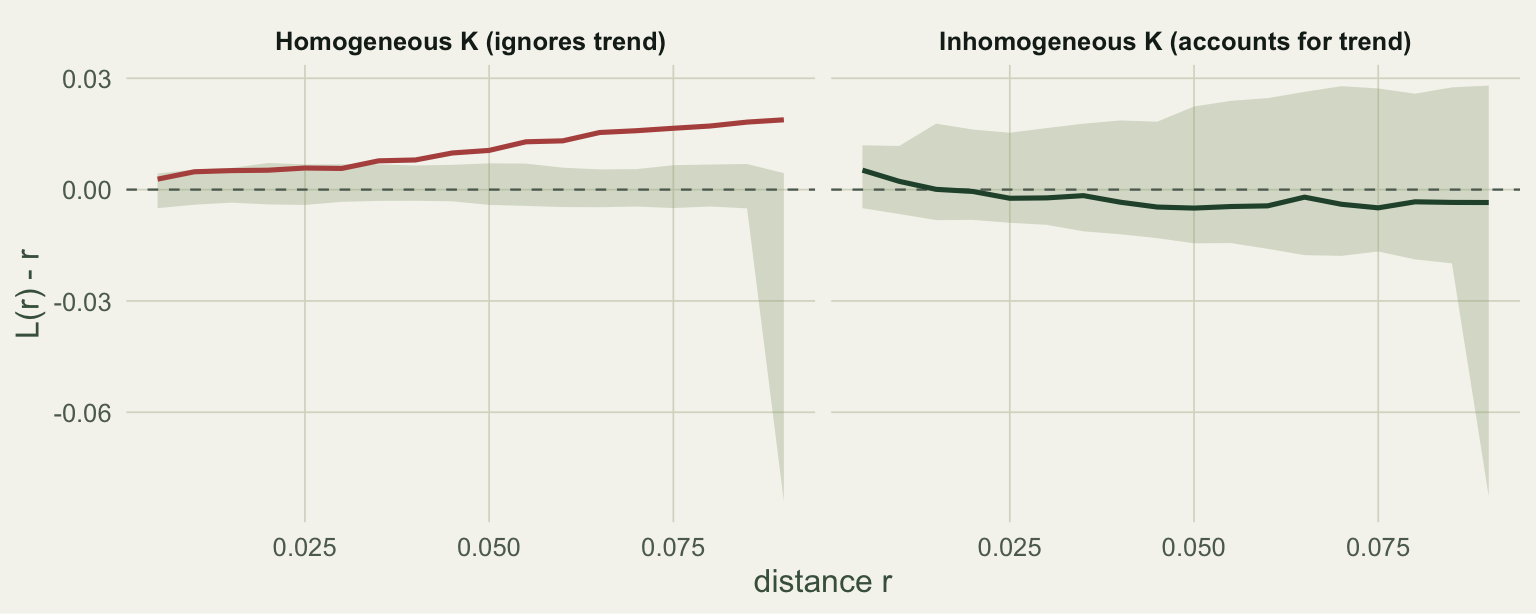
The homogeneous curve leaves the random envelope, climbing to an L minus r of about 0.019 at the largest distances: a clear, and entirely spurious, signal of clustering. The inhomogeneous curve is a different animal. Its largest excursion is only 0.005, and it stays inside the envelope at every distance. Once the trend is divided out, the residual second-order structure is flat, which is the correct answer: these points were independent all along.
```{r}
#| label: fig-kinhom
#| fig-cap: "L(r) minus r for the same pattern under a homogeneous K (left) and an inhomogeneous K (right), each against its own envelope."
#| fig-alt: "Two panels of L(r) minus r. On the left, labelled homogeneous, the curve rises out of the shaded envelope, a spurious clustering signal. On the right, labelled inhomogeneous, the curve stays flat and inside the envelope."
#| fig-width: 8.0
#| fig-height: 3.2
df <- rbind(
  data.frame(r = r_seq, val = obs_hom,   lo = h_lo, hi = h_hi,
             which = "Homogeneous K (ignores trend)"),
  data.frame(r = r_seq, val = obs_inhom, lo = i_lo, hi = i_hi,
             which = "Inhomogeneous K (accounts for trend)"))
df$which <- factor(df$which, levels = c("Homogeneous K (ignores trend)",
                                        "Inhomogeneous K (accounts for trend)"))
ggplot(df, aes(r)) +
  geom_ribbon(aes(ymin = lo, ymax = hi), fill = te_sage, alpha = 0.30) +
  geom_hline(yintercept = 0, colour = te_faint, linetype = "dashed", linewidth = 0.4) +
  geom_line(aes(y = val, colour = which), linewidth = 0.9) +
  facet_wrap(~ which) +
  scale_colour_manual(values = c(te_rust, te_forest), guide = "none") +
  labs(x = "distance r", y = "L(r) - r") +
  theme_te()
```
## Reading the result, and its limits
The two curves together carry the whole lesson. A hot-spot of high density looks identical to clustering under a homogeneous analysis, because both crowd points closer together. Only by modelling the first-order trend can you ask the second-order question cleanly: given where the density is high and low, are points still closer, or farther, than independence would put them? Here the answer is neither, and the inhomogeneous K says so. Had we layered genuine clustering on top of the trend, the same inhomogeneous K would have flagged the leftover aggregation while ignoring the gradient, which is the whole reason the tool exists.
Two cautions keep this honest. The inhomogeneous K is only as good as the intensity you feed it, and the intensity is estimated from the same points you are testing. Fit too flexible a trend and it will soak up real clustering, flattening a signal that should show; fit too rigid a trend and leftover density variation will leak through as spurious interaction. There is a genuine identifiability tension between a smoothly varying intensity and short-range clustering, because both put extra points close together, and no amount of arithmetic fully resolves it from a single pattern. The safe practice is to justify the trend model on external grounds, from the covariates you believe drive abundance, rather than tuning it until the K curve looks the way you expected.
That closes the loop this series opened. Quadrats gave a first, coarse test of randomness; nearest-neighbour distances sharpened it to the finest scale; Ripley's K spread it across all scales; and the inhomogeneous K let the density itself vary, so that the pattern in the points can finally be told apart from the pattern in their abundance.
## References
Baddeley AJ, Moller J, Waagepetersen R 2000 Statistica Neerlandica 54(3):329-350 (10.1111/1467-9574.00144)
Lewis PAW, Shedler GS 1979 Naval Research Logistics Quarterly 26(3):403-413 (10.1002/nav.3800260304)
Wiegand T, Moloney KA 2014 Handbook of Spatial Point-Pattern Analysis in Ecology. Chapman and Hall/CRC. ISBN 978-1-4200-8254-8
Diggle PJ 2013 Statistical Analysis of Spatial and Spatio-Temporal Point Patterns, 3rd edition. Chapman and Hall/CRC. ISBN 978-1-4665-6023-9
## Related tutorials
- [Ripley's K and the pair correlation function](../ripleys-k-function/)
- [Self-exciting events and the Hawkes process](../self-exciting-events-and-the-hawkes-process/)
- [Offsets for rates and densities in R](../offsets-for-rates-and-densities/)
- [MaxEnt as a Poisson point process](../maxent-as-a-point-process/)