---
title: "Strategies in the iterated game"
description: "Evolutionary dynamics of iterated prisoner's dilemma strategies in R: why cooperation and defection are both stable, and the start that decides which wins."
date: "2026-07-08 09:00"
date-modified: "2026-10-14"
categories: [evolutionary ecology, evolutionary game theory, social evolution, R, ecology tutorial]
image: thumbnail.png
image-alt: "Final fraction of defectors against their starting fraction, jumping from zero to one at a high threshold near 0.94"
---
*Corrected 14 October 2026: the post said that the clean bistability dissolves once players make mistakes; it now says that mistakes shrink the basin of attraction of tit-for-tat, while at small error rates defection and tit-for-tat both stay stable against each other.*
*Corrected 7 October 2026: the post said that in its model cooperation slowly erodes from the inside and can then be toppled, which is why real cooperative systems tend to need active policing; it now says that deterministic replicator dynamics like the ones it runs contain no drift and cannot show that erosion, which needs a finite population, and it no longer draws the conclusion about policing.*
*Corrected 1 October 2026: the post said a handful of reciprocators is usually enough to pull a population toward cooperation; in this deterministic model it is any share of reciprocators above the threshold the post computes, and the post now gives that share.*
[Tit-for-tat resists defection](../direct-reciprocity-and-tit-for-tat/) once the future counts enough, but that is not the same as saying cooperation always wins. In the repeated game both cooperation and defection can be stable, and which one a population ends up in depends on where it starts. This post runs the evolutionary dynamics of a few classic strategies in base R and finds the tipping point between a cooperative world and a selfish one.
## A tournament of strategies
Take three strategies for the repeated prisoner's dilemma: always defect, always cooperate, and tit-for-tat. Using the same memory-one payoff engine as the [previous post](../direct-reciprocity-and-tit-for-tat/), build the matrix of per-round payoffs, each strategy against each, at a continuation probability of 0.9.
```{r}
#| label: engine
Tt <- 5; R <- 3; P <- 1; S <- 0
payoff_vec <- c(R, S, Tt, P); swap <- c(1, 3, 2, 4)
strat <- function(p, open = 1) list(p = p, open = open)
strategies <- list(ALLD = strat(c(0, 0, 0, 0), 0),
                   ALLC = strat(c(1, 1, 1, 1), 1),
                   TFT  = strat(c(1, 0, 1, 0), 1))
per_round <- function(A, B, w = 0.9) {
  a0 <- A$open; b0 <- B$open
  pi0 <- c(a0*b0, a0*(1-b0), (1-a0)*b0, (1-a0)*(1-b0))
  M <- matrix(0, 4, 4)
  for (s in 1:4) { ca <- A$p[s]; cb <- B$p[swap[s]]
    M[s, ] <- c(ca*cb, ca*(1-cb), (1-ca)*cb, (1-ca)*(1-cb)) }
  as.numeric((1 - w) * pi0 %*% solve(diag(4) - w * M) %*% payoff_vec)
}
nm <- names(strategies)
G <- outer(seq_along(nm), seq_along(nm),
           Vectorize(function(i, j) per_round(strategies[[i]], strategies[[j]])))
dimnames(G) <- list(nm, nm)
round(G, 2)
```
Read the matrix by row: tit-for-tat earns 3 against itself and against a cooperator, but only 0.9 against a defector. A defector earns 5 against a naive cooperator, but just 1.4 against tit-for-tat and 1 against another defector. Exploiting cooperators is lucrative; meeting reciprocators or fellow defectors is not.
## Two stable worlds
Defection is evolutionarily stable, and tit-for-tat is stable against defectors, which is not quite the same thing. A defector in a defector world earns 1, more than the 0.9 a lone tit-for-tat would get, so defection resists invasion. A tit-for-tat in a tit-for-tat world earns 3, far above the 1.4 a defector would get, so cooperation resists defection too. It is not a strict ESS: an unconditional cooperator also earns 3 against tit-for-tat and 3 against another cooperator, so nothing selects it out while defectors are absent, which is the leak the next section picks up.
```{r}
#| label: ess
cat(sprintf("all-defect world: ALLD earns %.2f, a TFT invader %.2f -> defection stable\n", G["ALLD","ALLD"], G["TFT","ALLD"]))
cat(sprintf("tit-for-tat world: TFT earns %.2f, an ALLD invader %.2f -> cooperation stable\n", G["TFT","TFT"], G["ALLD","TFT"]))
```
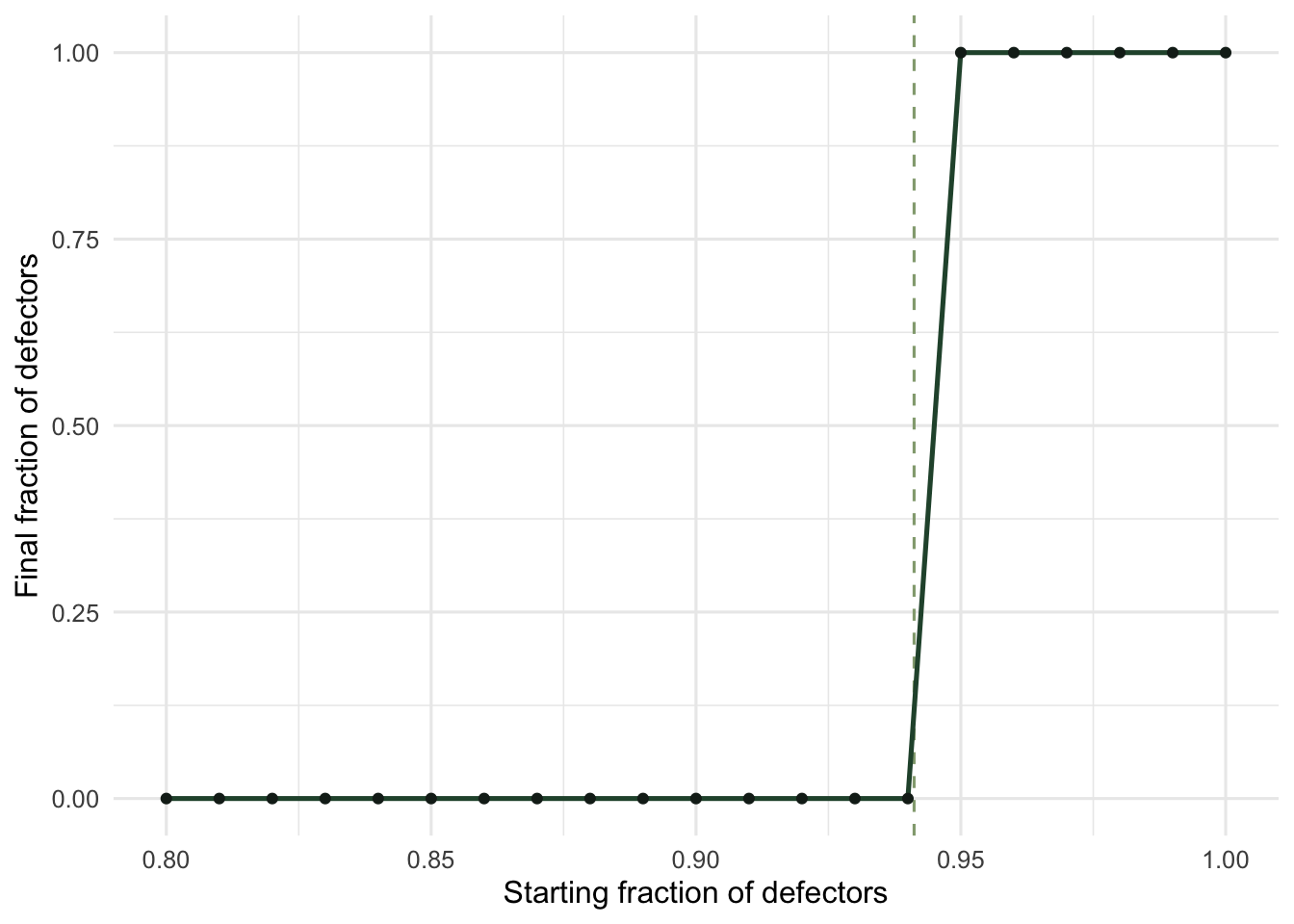
With two stable states the outcome hinges on the starting mix, exactly like [alternative stable states](../priority-effects-and-alternative-states/) in community ecology. Run the replicator dynamics for defectors against tit-for-tat from many starting frequencies and watch where each ends up.
```{r}
#| label: bistable
replicator2 <- function(xD, dt = 0.05, tmax = 2000) {
  M <- G[c("ALLD","TFT"), c("ALLD","TFT")]; x <- c(xD, 1 - xD)
  for (i in seq_len(tmax/dt)) { f <- as.numeric(M %*% x); x <- x + dt*x*(f - sum(x*f))
    x <- pmax(x, 1e-12); x <- x/sum(x) }
  x[1]
}
thr <- (G["ALLD","TFT"] - G["TFT","TFT"]) /
       ((G["ALLD","TFT"] - G["TFT","TFT"]) + (G["TFT","ALLD"] - G["ALLD","ALLD"]))
cat(sprintf("unstable threshold: defectors win only above %.3f of the population\n", thr))
cat(sprintf("start 90%% defectors -> %.0f%% defectors;  start 97%% -> %.0f%% defectors\n",
            100*replicator2(0.90), 100*replicator2(0.97)))
```
The separatrix sits at 0.941. Defection takes over only if it already makes up more than 94% of the population; a population that is 90% defectors still slides all the way back to cooperation, while one at 97% tips into universal defection. Tit-for-tat has an enormous basin of attraction. Any share of reciprocators above `r sprintf("%.1f", 100 * (1 - thr))`% is enough to pull the population all the way to cooperation, which is the core reason reciprocity is a plausible route out of the dilemma.
```{r}
#| label: fig-bistable
#| fig-cap: "Final fraction of defectors against their starting fraction, from the replicator dynamics of always-defect versus tit-for-tat. The outcome jumps at 0.941: below it cooperation wins, above it defection does. Two stable states, a high threshold between them."
#| fig-alt: "A step function: final defector fraction stays near zero until the starting fraction reaches about 0.94, then jumps to one."
library(ggplot2)
te_canvas <- theme(plot.background  = element_rect(fill = "#f5f4ee", colour = NA),
                   panel.background = element_rect(fill = "#f5f4ee", colour = NA))
x0 <- seq(0.80, 1.0, 0.01)
d <- data.frame(start = x0, final = sapply(x0, replicator2))
ggplot(d, aes(start, final)) +
  geom_vline(xintercept = thr, linetype = "dashed", colour = "#93a87f") +
  geom_line(colour = "#275139", linewidth = 0.9) + geom_point(colour = "#16241d", size = 1.4) +
  labs(x = "Starting fraction of defectors", y = "Final fraction of defectors") +
  theme_minimal(base_size = 12) + te_canvas
```
## The weak point: naive cooperators
That large basin has a leak. A population of tit-for-tat earns 3 against itself, but so does always-cooperate: reciprocators and unconditional cooperators are indistinguishable while no defector is present, so nothing stops always-cooperate from drifting in by chance. Once enough naive cooperators accumulate, they become food, and a defector that could not have invaded pure tit-for-tat now finds easy meals. Replicator dynamics like those above cannot show this, because they contain no drift: with always-cooperate added and no defectors present, its share stays wherever it starts, and a rare defector can begin to spread only once unconditional cooperators are common enough for its gains from them to outweigh its losses against tit-for-tat. In a finite population, where chance can carry always-cooperate that far, cooperation is not a fortress; it is a stable state that can slowly erode from the inside and then be toppled.
## An honest limit
The dynamics here assume error-free play, a fixed continuation probability, and a small hand-picked set of strategies. All three matter. The strategy set is not exhaustive, and a strategy outside it can overturn the ranking. Mistakes shrink the basin of attraction of tit-for-tat: a slip against an unforgiving partner triggers a feud, which the [checking post](../checking-a-reciprocity-model/) examines, and tit-for-tat then earns less against itself, although at small error rates defection and tit-for-tat both stay stable against each other. And the whole picture is built at one value of the continuation probability; lower it below the [reciprocity threshold](../direct-reciprocity-and-tit-for-tat/) and cooperation stops being stable at all.
## References
Axelrod R 1984. The Evolution of Cooperation. Basic Books. ISBN 978-0465021215
Nowak MA, Sigmund K 1992. Nature 355(6357):250-253 (10.1038/355250a0)
Nowak MA, May RM 1992. Nature 359(6398):826-829 (10.1038/359826a0)
## Related tutorials
- [The prisoner's dilemma](../the-prisoners-dilemma/)
- [Direct reciprocity and tit-for-tat](../direct-reciprocity-and-tit-for-tat/)
- [Assessment rules for reputation](../assessment-rules-and-reputation/)
- [Priority effects and alternative stable states](../priority-effects-and-alternative-states/)