library(ape)
library(ggplot2)

te_paper <- "#f5f4ee"; te_ink   <- "#16241d"; te_body <- "#2c3a31"
te_faint <- "#5d6b61"; te_sage  <- "#93a87f"; te_rust <- "#b5534e"
te_line  <- "#dad9ca"; te_green <- "#2f8f63"; te_gold <- "#cda23f"
te_forest <- "#275139"

theme_te <- function(base_size = 12) {
  theme_minimal(base_size = base_size) +
    theme(
      plot.background  = element_rect(fill = te_paper, colour = NA),
      panel.background = element_rect(fill = te_paper, colour = NA),
      panel.grid.major = element_line(colour = te_line, linewidth = 0.3),
      panel.grid.minor = element_blank(),
      axis.text  = element_text(colour = te_body),
      axis.title = element_text(colour = te_ink),
      plot.title = element_text(colour = te_ink, face = "bold"),
      strip.text = element_text(colour = te_ink, face = "bold")
    )
}Ancestral state reconstruction in R
R
ape
phylogenetics
comparative methods
ecology tutorial
Ancestral state reconstruction in R with ape: fitting continuous and discrete trait models with ace, reading node uncertainty, and when not to trust it.
Ancestral state reconstruction asks what a trait looked like at the internal nodes of a phylogeny: the value carried by a common ancestor, inferred from the values measured in its living descendants. It is how comparative biologists put numbers on the past, whether that past is the body size of an ancestral finch or the habitat a lineage occupied before it diversified. The estimate is always a model-based guess, and the honest form of the answer carries an interval around it. This post fits one continuous and one discrete reconstruction in R with ape, and spends as much attention on the uncertainty as on the point estimate.
Reconstructing a continuous trait
For a continuous trait the usual model is Brownian motion: the trait drifts up or down at random along every branch, with variance proportional to time. ace fits this by maximum likelihood and returns an estimate at every internal node, each with a 95% confidence interval. We simulate a trait on a forty-tip tree with a true root value of zero, then ask the method to recover it.
set.seed(7)
tr_c <- rcoal(40)
tr_c$tip.label <- sprintf("t%02d", 1:40)
set.seed(20)
xc <- rTraitCont(tr_c, model = "BM", sigma = 1, root.value = 0)  # true root = 0

fit_c <- ace(xc[tr_c$tip.label], tr_c, type = "continuous", method = "ML")
root_est <- fit_c$ace[1]        # first internal node is the root
root_ci  <- fit_c$CI95[1, ]
c(root_estimate = root_est, lower = root_ci[1], upper = root_ci[2])
root_estimate.41 lower upper
0.01210844 -0.77879659 0.80301347 The reconstructed root value is 0.01 against a true zero. The number on its own says less than the interval beside it: the 95% CI runs from -0.78 to 0.8, a span of 1.58 trait units, about 42 per cent of the entire spread among the living species and about as wide as their interquartile range. Wherever the point estimate happens to land, the interval is the part you should quote. A single realisation of Brownian motion drifts freely, so the root is only ever pinned down loosely, and a reconstruction reported without its interval hides exactly how loose that is.
The interval also grows with depth. Nodes near the tips sit close to a couple of measured species and inherit tight bounds; the root sits behind the whole depth of the tree, and every branch between it and a tip is another chance for the trait to drift, so it gets the widest bound of all.
Ntip <- length(tr_c$tip.label)
nn   <- (Ntip + 1):(Ntip + tr_c$Nnode)
bt   <- branching.times(tr_c)
dfc  <- data.frame(node = nn, age = as.numeric(bt[as.character(nn)]),
                   est = fit_c$ace, lo = fit_c$CI95[, 1], hi = fit_c$CI95[, 2])
dfc$root <- dfc$node == (Ntip + 1)
ggplot(dfc, aes(age, est)) +
  geom_hline(yintercept = 0, colour = te_faint, linetype = "22") +
  geom_linerange(aes(ymin = lo, ymax = hi, colour = root), linewidth = 0.6, alpha = 0.8) +
  geom_point(aes(colour = root), size = 1.8) +
  scale_colour_manual(values = c(`FALSE` = te_sage, `TRUE` = te_rust), guide = "none") +
  scale_x_continuous(transform = scales::compose_trans(scales::sqrt_trans(),
                                                       scales::reverse_trans()),
                     breaks = c(0, 0.05, 0.2, 0.5, 1)) +
  annotate("text", x = max(dfc$age), y = dfc$est[dfc$root] + 0.18, label = "root",
           colour = te_rust, hjust = 0, size = 3.5, fontface = "bold") +
  labs(x = "node age (time before present)", y = "reconstructed trait value",
       title = "Uncertainty grows toward the root") +
  theme_te(12)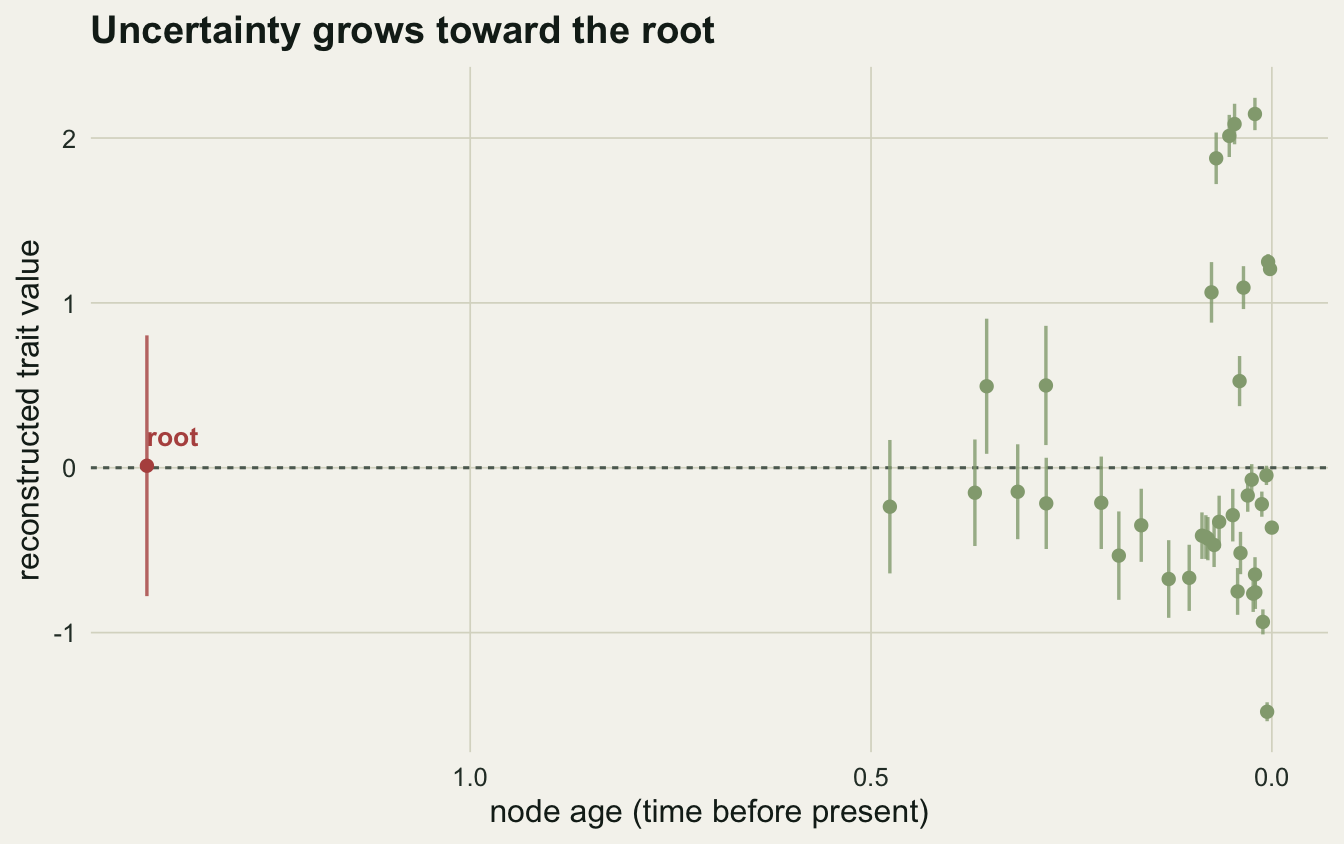
Reconstructing a discrete trait
Discrete traits, such as a habitat coded as open or forest, use a continuous-time Markov model instead. The simplest version, the equal-rates or ER model, allows changes in either direction at one shared rate. ace estimates that rate and returns, for every node, the scaled likelihood of each state: a probability that the ancestor was open rather than forest. We simulate a two-state habitat on a thirty-six-tip tree and reconstruct it.
set.seed(58)
tr_d <- rcoal(36)
tr_d$tip.label <- sprintf("s%02d", 1:36)
set.seed(58)
xd <- suppressWarnings(rTraitDisc(tr_d, model = "ER", k = 2, rate = 0.6,
                                  states = c("open", "forest"), root.value = 1))
tb <- table(factor(xd, levels = c("open", "forest")))

fit_d <- ace(xd[tr_d$tip.label], tr_d, type = "discrete", model = "ER")
rootp <- fit_d$lik.anc[1, ]           # state probabilities at the root
c(rate = unname(fit_d$rates), rootp)
rate open forest
0.2194242 0.8065936 0.1934064 The tips split 16 open and 20 forest, and the estimated transition rate is 0.22. At the root the model puts 81% of the probability on open and 19% on forest. The pair of probabilities is the answer, not either one on its own. Reporting only “the ancestor was open” would throw away the other number.
A node close to the tips sits behind a couple of short branches and is pinned by the states of its few descendants; a deep node sits behind many branches on which the habitat could have changed.
co <- c(open = te_gold, forest = te_forest)
par(bg = te_paper, mar = c(0, 0, 2, 0))
plot(tr_d, show.tip.label = FALSE, edge.color = te_faint, edge.width = 1.3)
title(main = "Tip states and node probabilities on the tree", col.main = te_ink,
      cex.main = 1.0, font.main = 2)
tiplabels(pch = 21, bg = co[as.character(xd[tr_d$tip.label])], col = te_paper, cex = 1.2)
nodelabels(pie = fit_d$lik.anc, piecol = c(te_gold, te_forest), cex = 0.45)
legend("bottomleft", legend = c("open", "forest"), pt.bg = c(te_gold, te_forest),
       pch = 21, col = te_paper, bty = "n", text.col = te_body, cex = 0.9)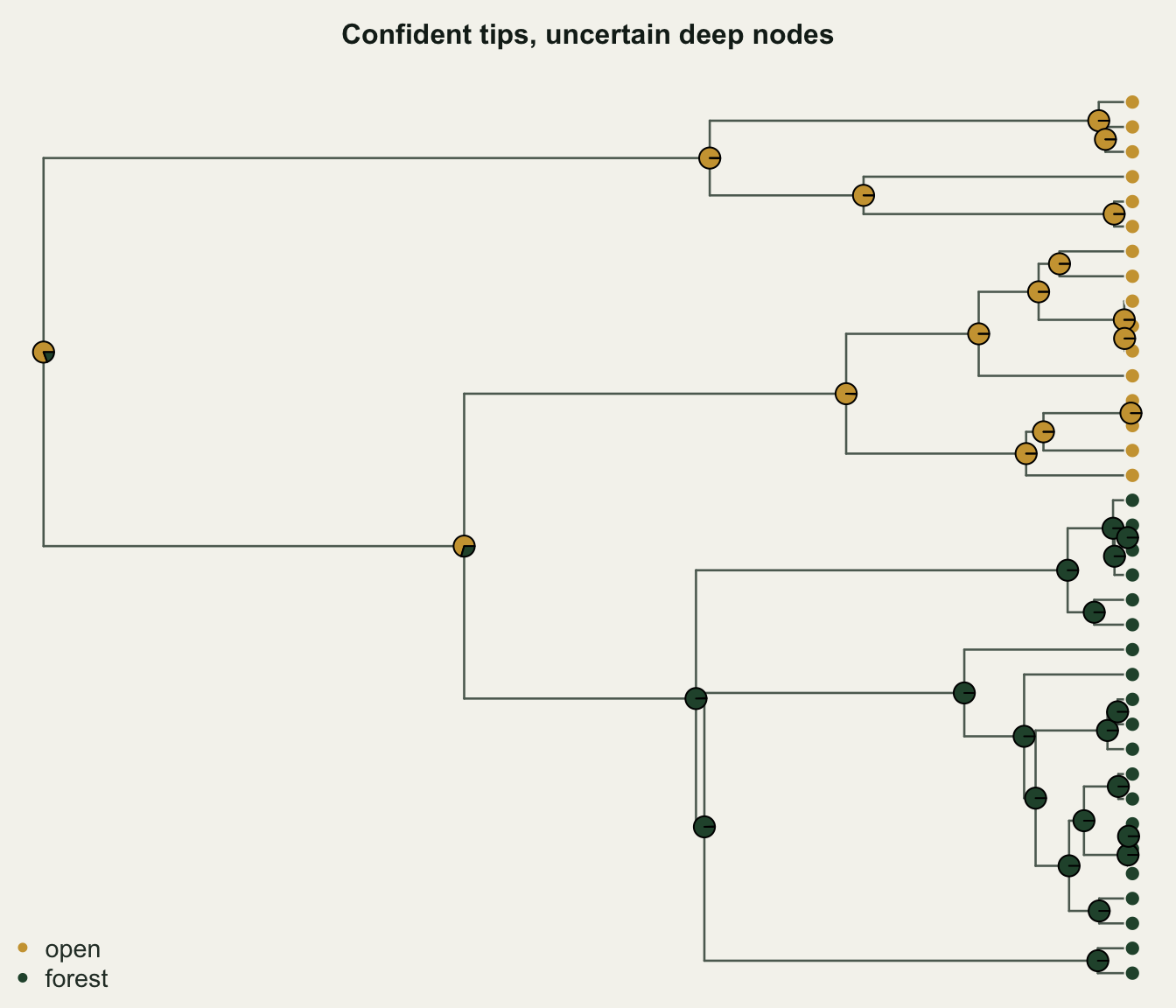
How much to trust it
A reconstruction is a statement about a model, not a memory of the past, and three limits follow from that. The estimate depends on the model you chose: Brownian motion assumes no trend, so if the trait was under directional selection the reconstructed root will be pulled toward the modern mean and mislead you. A single trait carries limited information about deep history, which is why the root interval was the widest one in the plot; adding more tips helps near the tips but does little for the root. And a point estimate on its own is close to meaningless here, because the whole value of the method is in the interval or the probability it reports alongside.
Used with that in mind, ace is a clear way to see both what the data suggest about the past and how firmly they suggest it. When the intervals are narrow the reconstruction is worth leaning on; when they are wide, as at a deep root, the right conclusion is often that the trait’s early history is simply not recoverable from living species alone. For questions about correlated change between traits, a method that tests the pattern directly, without committing to reconstructed ancestors, is usually the safer tool, and the tree-aware regression in phylogenetic generalised least squares is one such route.
References
- Felsenstein 1985 The American Naturalist 125(1):1-15 (10.1086/284325)
- Schluter et al 1997 Evolution 51(6):1699-1711 (10.1111/j.1558-5646.1997.tb05095.x)
- Pagel 1994 Proceedings of the Royal Society B 255(1342):37-45 (10.1098/rspb.1994.0006)
- Paradis & Schliep 2019 Bioinformatics 35(3):526-528 (10.1093/bioinformatics/bty633)